Pre-trip vs. In-car information: What is the difference regarding roadworks and closures?
Roadworks and closures cause inconvenience, but good information provision can significantly limit that inconvenience. Road users want to know what to expect at the right moment: before they leave, and while they are on the road. These are two different moments of information, each with its own channels, technology, and goal: pre-trip information and in-car information. For road authorities, it is crucial to understand both well and align them, especially when communicating about road works.
In this article, we explain exactly what pre-trip information and in-car information entail, how they differ, and how you, as a road manager, can effectively use them around roadworks.
When road users do not know what to expect, uncertainty, unexpected maneuvers, and frustration arise. This has a direct impact on both road safety and traffic flow. Precisely for this reason, communication is increasingly seen as an essential part of professional traffic management.
What is pre-trip information?
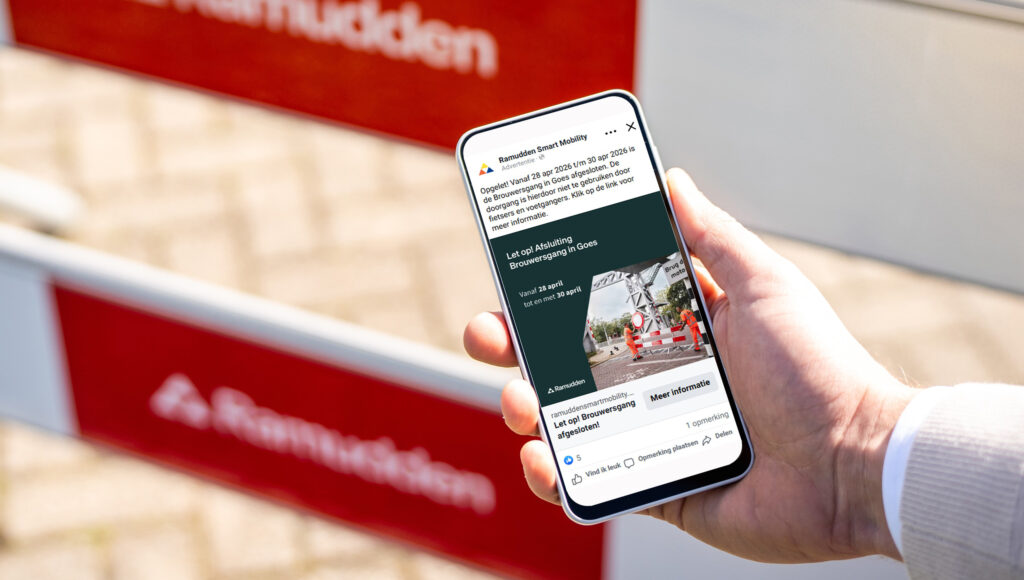
Pre-trip information is all traffic information that a traveler consults. before He or she departs. The goal is to enable the road user to make an informed choice in advance regarding the route, departure time, or mode of transport.
Typical characteristics of pre-trip information:
- Moment: at home, at the office, or somewhere else before the start of the ride.
- Channels: websites and apps of road authorities, route planners, traffic information services, social media channels, local media and advance notice signs (for example “roadworks from [date]”).
- Target: behavioral change encourage before departure, such as choosing an alternative route, a different time, or the bicycle or public transport instead of the car.
- Level of detail: often somewhat more detailed and with more context, such as the reason for the work, the expected duration, and alternative routes.
For road authorities, pre-trip information is the ultimate tool for distributing or diverting traffic before the closure, thereby reducing pressure on the road network during the works.
What is in-car information?
In-car information is the traffic information that a road user during the day The driver receives information, usually via the navigation system, a traffic app on the smartphone, or dynamic route information panels (DRIPs) along the road.
Typical features of in-car information:
- Moment: while the road user is already on the move.
- Channels: built-in navigation systems, smartphone apps (such as Google Maps, TomTom, Flitsmeister), traffic information via the car radio, and DRIPs above or next to the road.
- Target: alert the driver to a closure, traffic jam, or diversion at the right moment, so that he or she can react immediately.
- Level of detail: short, current, and to the point. Think of “closure in 2 km, follow diversion” instead of an extensive explanation.
In-car information must be lightning-fast and reliable. The data often comes from the same source as pre-trip information, but is presented differently: shorter, more action-oriented, and tailored to the driving context.
Pre-trip information versus in-car information: the key differences
|
Pre-trip information |
In-car information |
|
|
Moment |
Before departure |
During the ride |
|
User location |
Home, office, elsewhere |
On the road, in the vehicle |
|
Main channels |
Website, app, social media, media |
Navigation system, traffic app, DRIP |
|
Target |
Influencing route and time choice |
Act immediately on the current situation |
|
Level of detail |
Extensive, with context |
Concise and action-oriented |
|
Impact on road management |
Traffic distribution in advance |
Smooth traffic flow during the ride |
The most important difference therefore lies in the moment of informing and the behavior that you want to influence with it. Pre-trip information focuses on the choice made in advance; in-car information focuses on the reaction in the moment itself.
Why this distinction is important during roadworks and closures
When planning and communicating about road works, combining both information moments is essential:
- Pre-trip information prevents unnecessary traffic on the route. By communicating a closure in a timely manner via the company's own website, app notifications, and traffic information services, road users can adjust their route before departure. This significantly reduces traffic congestion around the work zone.
- In-car information intercepts road users who are still driving towards the closure. Not everyone checks traffic information in advance. Current, real-time warnings in the car ensure that drivers approaching the route can take a detour in time.
- Both channels must share the same, up-to-date data. For road authorities, this means that basic information regarding a closure or work section (location, period, diversion route) must be managed and shared in one central location, for example via the National Road Traffic Data Bank (NDW) and the DATEX II format. From this source, both pre-trip channels (websites, apps) and in-car channels (navigation, DRIPs) can be automatically and consistently fed.
- Consistency prevents confusion and mistrust. If the pre-trip information indicates a different detour than the in-car information, the road user loses confidence in both sources. Unambiguous, standardized data delivery is therefore just as important as the content itself.
Practical recommendations for road managers
- Report works and closures as early as possible. via pre-trip channels, with concrete dates, duration, and alternative routes. Think not only of your own website, but also of targeted digital environmental communicationVia social media, geofencing, and hyper-personalization, you can reach exactly the road users and local residents who will actually be affected by the works. Ramudden Smart Mobility specializes in this type of targeted, digital pre-trip communication for road authorities and contractors.
- Submit current roadworks data in a structured manner. with national or regional traffic databases, so that navigation and traffic apps can automatically process this as in-car information. Go beyond merely supplying data: navigation apps such as Google Maps do not automatically direct traffic via the desired detour route and regularly lead road users through residential areas via unwanted shortcuts. navigation influence, With, as offered by Ramudden Smart Mobility, you can have apps actively steer towards your desired route, without extra signage or enforcement.
- Align DRIP texts and in-car messages with the pre-trip message, so that road users see a recognizable, consistent notification while on the road. Because Ramudden Smart Mobility manages both digital environmental communication (pre-trip) and navigation influence (in-car) from a single party, the message regarding a closure remains consistent, from the initial online announcement to the notification in the car.
- Monitor and update the status of roadworks is continuously monitored, ensuring that both pre-trip and in-car information corresponds to the actual situation on the road at all times. Furthermore, with the monitoring and data insights from Ramudden Smart Mobility, you can demonstrate the effect of your communication and traffic management, and substantiate decisions to the authorities and local residents.
- Consider a specialized partner for digital traffic communication. Combining pre-trip and in-car information requires knowledge of both communication and traffic engineering data. Road authorities Those who do not wish to set this up entirely themselves can collaborate with a party like Ramudden Smart Mobility, which offers pre-trip communication, navigation influence, and monitoring as a cohesive package.
Conclusion
Pre-trip information and in-car information are not competing but rather complementary links in the information chain surrounding roadworks and closures. Pre-trip information gives road users the opportunity to make a different choice in advance; in-car information ensures that those who are already on the road are directed to correct their course at the right moment. By basing both forms of information provision on the same, up-to-date, and standardized data, road authorities can significantly reduce the impact of roadworks on traffic flow and road safety.