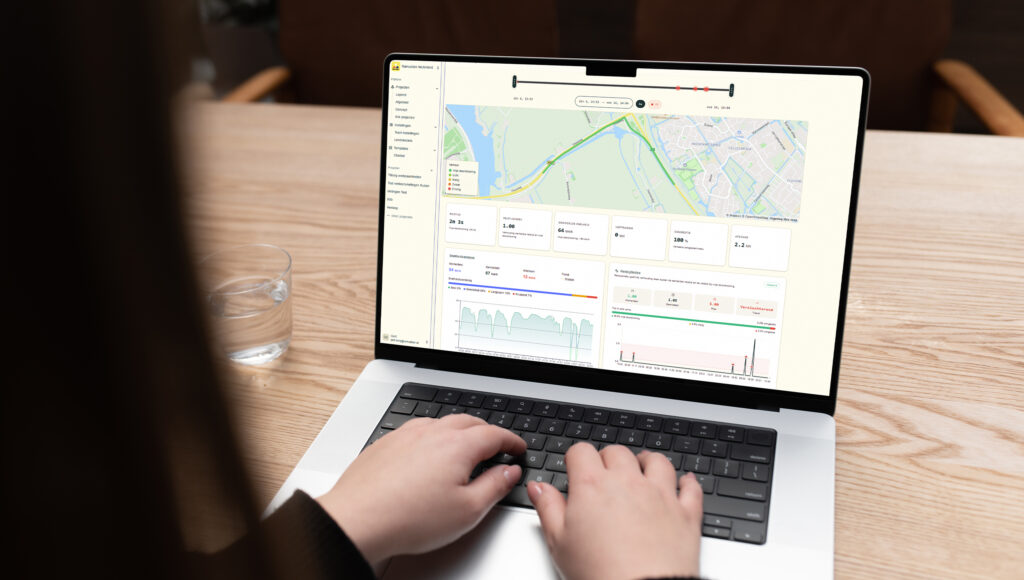
Traffic data at roadworks: from perception to evidence
During roadworks, temporary traffic situations, and closures, facts and perception often become intertwined. A resident experiences increased traffic in the street, a business owner indicates that his shop is less accessible, and a road user reports extra delays on his route. Such signals seem in themselves sufficient proof that the temporary traffic measures are not working. But without traffic data that remains an assumption.
Why experience alone provides insufficient insight during roadworks
In traffic projects, many decisions are made under pressure. This is especially true for roadworks, closures, diversions, or work in busy urban areas. It must be determined quickly whether a temporary traffic measure is functioning effectively, whether additional measures are necessary, and how complaints or reports should be assessed.
Subjective signals play a major role in this. These include complaints from residents, observations by traffic controllers, reports from road users, input from business owners, or impressions from the project team. These signals are important because they show what is going on in the local community.
At the same time, they are often based on a specific moment or a personal experience. One busy morning can define the picture. A queue that makes a strong impression is not necessarily structural. And a street that feels busier does not always demonstrably handle more traffic.
The reverse can also happen. Sometimes there are few complaints, while traffic data shows that speeds are too high, a diversion is not followed sufficiently, or queues recur at fixed times. That is precisely why it is important to connect feelings with facts.
Traffic data and experience: how they complement each other
In traffic projects, it is not a choice between experience or data. The greatest value is created precisely when both are combined.
Subjective data is about experience and perception.
What do residents, road users, business owners, or operational teams experience? Where does frustration arise? Where do situations feel unsafe? Which routes are perceived as illogical or unclear?
Objective traffic data provides insight into what is happening in a measurable way.
Consider traffic intensities, speeds, travel times, queues, vehicle categories, bicycle and pedestrian flows, route usage, and peak times.
By placing these two types of information side by side, a much clearer picture emerges. A complaint about shortcut traffic, for example, can be verified using traffic counts. A report about unsafe driving behavior can be compared with speed data. And a discussion about poor traffic flow can be substantiated with travel time measurements or queue information.
That is how the conversation changes. No longer: “We think it's not too bad.” versus “The neighborhood is experiencing a nuisance.”". But: "“This is what we hear from the community, this is what we see in the data, and this is what it means for the measures.”

Traffic data as substantiation for the local community and the client
For road authorities Traffic data is valuable in discussions with residents, administrators, and other stakeholders. Reports regarding traffic nuisance or safety often require a careful response. Objective data makes it possible to explain more clearly what is happening, what considerations have been made, and which adjustments are or are not necessary.
That does not mean that experience becomes less important. On the contrary. A situation can remain measurably within acceptable limits and still be perceived as unpleasant. That, too, is relevant information. But by combining experience with data, a fairer and more concrete conversation emerges.
For contractors Traffic data helps to better manage implementation. It makes visible whether temporary traffic measures are working as intended. It also helps to better substantiate agreements regarding accessibility, disruption mitigation, and safety. When a dispute arises regarding the impact of works, data provides a factual basis.
Adjust course faster during roadworks using traffic measurements
An important advantage of traffic data is that problems become visible sooner. Not only after a series of complaints or at the end of the project, but during implementation.
In temporary traffic situations, circumstances can change rapidly. Traffic seeks alternative routes other than expected. A closure has a greater impact on the surrounding area than initially anticipated. An intersection experiences excessive pressure at certain times. Or pedestrians and cyclists do not choose the route that seemed logical on paper.
Monitoring and smart sensors make it possible to identify bottlenecks more quickly. This makes corrective action more practical, not based on a general feeling that “it is busy,” but on concrete information regarding locations, times, and traffic flows.
Using traffic data to improve future traffic projects
Traffic data Data has value not only during a project. After completion, data also offers important insights. Which diversion worked well? Where did structural disruption occur? Which reports were confirmed by measurements? Where did the perception deviate from the actual situation? And which measures had a demonstrable effect?
Evaluating projects in this way creates a learning approach. Road authorities and contractors can better prepare for future traffic projects. Experience remains indispensable in this process, but is reinforced by facts.
This is important because pressure on public space is increasing. There are more roadworks, more modes of transport, and higher expectations regarding accessibility, safety, and communication. It is precisely then that traffic data helps to make choices more explainable and defensible.
- Would you like to know more about how traffic measurements can contribute to your project?
Contact us for a no-obligation consultation.